

Digitala Stambanan IndTech Etapp 3
To achieve greater resource efficiency, as demanded by industrial circular business models such as scope 3 solutions, transparency and standardized information exchange are required. The product life cycle is an important part of this adaptation, but there is still a need for increased information exchange between companies—for example through Digital Product Passports—which the Digitala Stambanan IndTech Stage 3 project specifically addresses.
The project’s task is, with a holistic perspective, broad expertise, and wide stakeholder involvement, to place products with different life cycles into a systemic context. In doing so, the project aims to generate efficiency, necessary values, and competitiveness for actors across the entire value chain.
Digitala Stambanan IndTech Stage 3 runs for three years, from November 1, 2024, to October 31, 2027. The project has a budget of SEK 20 million, with half consisting of industrial contributions (co-financing) and half funded by Vinnova through the Advanced Digitalization program.
Project Idea
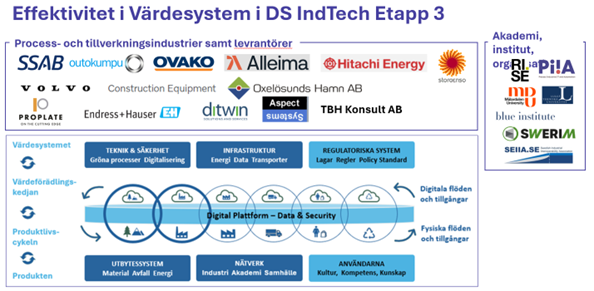
Based on the industrial needs that have emerged during previous project stages, this project focuses on three thematic areas within three different value systems:
-
User collaboration, culture, competence, and knowledge, including the handling of organizational challenges.
-
Regulatory systems and standards in the value chain and circular product life cycles.
-
A focus on Digital Product Passports and their digital platforms.
-
Data and security for digital value chains, linking users with regulatory systems and their digital platforms.
The project consists of two industry cases (IC) and three work packages (WP).
IC1: Digital Product Passports with their digital platforms, data, and security
In IC1, RISE, LTU, SSAB, Proplate, Volvo CE, and Oxhamn collaborate to develop future-proof Digital Product Passports (DPP). The focus is on how data from OT, IT, and IoT can be transformed from internal silos into semantically linked, shareable, and value-creating information. Through mock-ups, PoCs, and interoperable solutions, the project addresses legal requirements, circularity, traceability, and business value—towards a digitally integrated and sustainable industry.
IC2: Users – collaboration, culture, competence, and knowledge
More information will follow.
WP2: Mobilization | Knowledge aggregation, industry collaboration, dissemination plan, demonstration, and implementation
The Digitala Stambanan model for knowledge management has two steps. The first, systematization, begins already during the problem-defining phases of the project. The final results are then packaged to meet the needs of the target groups. This activity is led by the research institute Blue Institute. In the second step, dissemination activities are carried out. To reach industry and contribute to inspiration and engagement, communication channels and methods are combined. In the current project, this is achieved through a series of seminars and the establishment of a larger reference group. This activity is led by SEIIA, the Swedish Industrial Interoperability Association.
WP1: Project Management and WP3: Project Communication
As the project begins to deliver results, more information will be added here for IC1, IC2, and WP2.
Project Goals
-
More companies in multiple value chains gain the insights, tools, and knowledge—that is, the capabilities—needed to continue developing and adapting their operations, thereby creating the conditions to contribute to overall system efficiency and circularity.
-
Collaboration based on trust, where actors share and make use of each other’s experiences and developed knowledge, in order to create value for themselves as well as for other actors in the value chains.
-
Enabling conditions for circular business models, scope 3 measures, and increased resource efficiency. The project primarily addresses Agenda 2030 Goals 9, 12, and 13, and indirectly several others.
-
By linking to relevant EU projects and initiatives, actors can both contribute to and benefit from specifications for information exchange.
-
Best Practice: the development of new methods, processes, or technologies with strong potential to increase efficiency, applicable across industries, thereby strengthening the overall competitiveness of Swedish industry.
-
The project addresses several prerequisites that must be met for data to be shared effectively. This is done through three of the four levels of interoperability used in various national and international contexts.
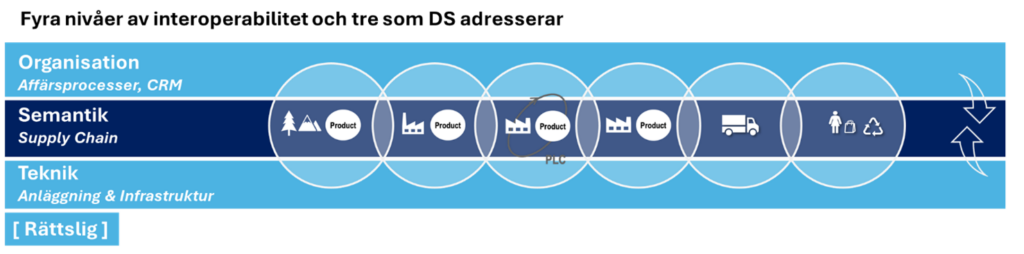
The organizational layer concerns how organizational conditions—such as governance and objectives—are designed.
Semantic interoperability means that data are structured in such a way that they can be made accessible, for example through the use of uniform standards.
Technical interoperability refers to the design of technical systems in a way that enables actual data sharing.
The legal layer, which has less direct relevance for industry, addresses the legal conditions necessary for data sharing.