
Digitala StambananDigitala StambananDigitala StambananDigitala Stambanan
  • Project
  • Production and IndTech
  • Insights
  • News
  • Contact
  • Swedish
  • Project
  • Production and IndTech
  • Insights
  • News
  • Contact
  • Swedish

Demonstrator – Digital platform for increased sustainability

  • 11/11/2024/
  • Posted By : Digitala Stambanan/
  • 0 comments /
  • Under : News, Summary of Digitala Stambanan

Digital platforms can revolutionize sustainability within the steel industry’s value chain. Learn about the demonstrators developed in the Digitala Stambanan project.

The Digitala Stambanan Production project has worked on different value chains. One of the value chains has focused on the steel industry. It has involved one company supplying steel, another company providing C-items, such as screws and nuts, which are delivered to a third company for machining, welding, painting, and assembling products for the automotive industry.

The work has focused on improving logistics flows, ensuring delivery reliability, and enhancing traceability for products and materials throughout the value chain.

Four focus areas were identified for mapping the maturity level of the value chain and explore possible technical solutions:

  1. Product data
  2. Delivery assurance
  3. Customer knowledge
  4. Green conversion

Two of these areas resulted in demonstrators – one showcasing the possibilities of digital platforms for the green conversion focus area and another focusing on delivery reliability. The two technology providers in the project have contributed their platforms to enable the development of these solutions.

Opportunities of digital platforms for sustainability

The first demonstrator uses ChainTraced’s platform, which focuses on traceability and carbon footprint visualisation throughout the value chain. With this solution, all companies in the value chain can visualize their carbon emissions, including Scope 1, 2, and 3 (See Figure 1). The platform’s “Traceback view” displays a tree structure where information about all components and their total climate impact can be traced (see Figure 2).
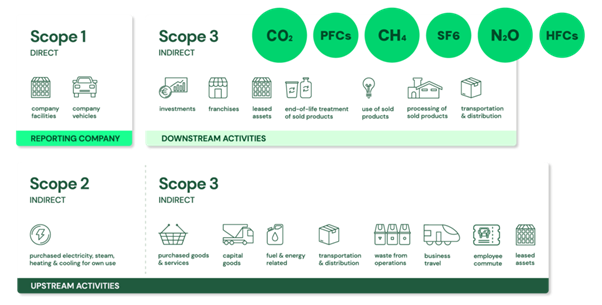
Figure 1 Scope 1, 2, and 3 emissions (Source: PlanA)

One of the central values of this solution is that the final product can be labeled with a stamp showing its environmental footprint throughout the manufacturing process. This helps companies identify where the most significant climate impact occurs in the value chain and promotes collaborations to reduce these emissions.

Challenges and future steps

The first version of the green coversion demonstrator used historical data and estimates to test the communication between companies in the value chain. CO2 data has been sent at the product level and is updated twice a year. The next step could involve collecting more realistic data at the batch level and for more material types.

A significant challenge is ensuring smooth integration between companies’ internal systems and the demonstrator. Additionally, physical and digital traceability must be synchronized throughout the value chain, which requires increased automation and coordination between different systems, including operational systems (OT) and business systems (IT).
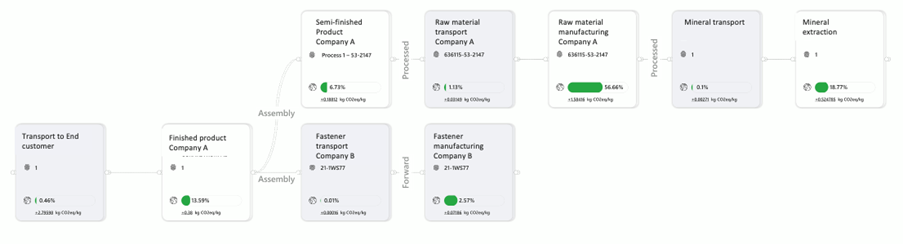
Figure 2 The ‘traceback view’ traceability tree generated from data collected from various actors in the value chain. The green bars represent the contribution to the total carbon footprint (Source: ChainTraced)

One of the main values ​​of this solution is that the final product can be labeled with a stamp that shows its environmental footprint throughout the manufacturing process. This helps companies identify where in the value chain the greatest climate impact occurs and promotes collaboration to reduce these emissions.

The members of our work package have tried to leverage data along the value chain and create clear visualizations where carbon footprints and products’ status can be viewed effectively. This work has never been more relevant with new directives for sustainability reporting (CSRD) and increased customer demands for green steel.

Article series in the fall of 2024

After several years of successful collaboration, we look forward to sharing this knowledge. During the fall, we will publish articles highlighting the challenges of digitalization in the industry, how we see that companies can address and benefit from technological development, and what we have achieved through the project. We will also emphasize the strength of this innovation collaboration and share participants’ experiences and insights.

We hope these articles will inspire more companies to embrace the opportunities of digitalization and understand the importance of collaboration for a future competitive Swedish industry.

Keep an eye out for upcoming articles on our website!

You can find all articles here

The Travel Guide – Vision, opportunities, and a roadmap for digitalization

  • 06/11/2024/
  • Posted By : Digitala Stambanan/
  • 0 comments /
  • Under : News, Summary of Digitala Stambanan

A clear vision and action plan are crucial for a successful digital transformation. Learn how to identify and streamline the needs of the value chain.

Within the Digitala Stambanan project, we have focused on value chains rather than individual companies. By identifying everyday needs and opportunities among the project’s participants, we have laid the foundation for how digitalization can strengthen collaboration and streamline processes across the entire value chain.

Create a clear vision for the future

To fully capitalize on digitalization’s potential, we recommend that companies start by formulating a clear vision. This vision should span 3–5 years into the future and include how digitalization can improve internal processes and interactions with customers and suppliers. Furthermore, it’s essential to consider how digitalization and AI can contribute to increased sustainability.

Identify needs and opportunities within the business

A vision statement is a guiding light for your company’s future position and will be essential as you explore digital technology opportunities. By starting with current needs, such as bottlenecks or time-consuming tasks, you can more easily identify areas where digitalization would make the most significant impact. One question to ask is whether access to specific information or technology could open up a different way of working that improves the next step in the process.

Workshop kit to broaden perspectives

To support companies on this journey, we have developed a workshop kit within the project. This tool helps companies look beyond their immediate scope and think more broadly than they might otherwise. The goal is to identify opportunities and challenges that digitalization may bring, thereby creating a stronger foundation for successful transformation processes.

Bridging the gap between industry and technology

A common challenge for many industrial companies is being aware of the possibilities of digital technology. In contrast, technology providers may need to understand the industry’s needs fully. The Digitala Stambanan project addresses this gap by bringing stakeholders from both sides together to foster mutual understanding and collaboration.

Tackle challenges early in the process

Identifying challenges early in the transformation journey makes it easier to address them – and sometimes, these challenges can even be turned into opportunities. Our workshop methodology presents common challenges the industry faces, which can be analyzed during the workshop. By mapping how these challenges manifest within the company, strategies can be developed to address or eliminate them.

Prioritize and create an action plan

Once companies have identified their vision, opportunities, and challenges, they prioritize and create an action plan. We recommend starting with initiatives that are easy to implement and deliver significant results. This helps establish early acceptance and a positive view of the change within the organization.

Shared priorities within the value chains

As previously mentioned, the project did not involve working with individual companies but instead focused on the entire value chain, selecting shared priorities. The results of this work will be presented in the following article.

Link to the Travel Guide
Article series in the fall of 2024

After several years of successful collaboration, we look forward to sharing this knowledge. During the fall, we will publish articles highlighting the challenges of digitalization in the industry, how we see that companies can address and benefit from technological development, and what we have achieved through the project. We will also emphasize the strength of this innovation collaboration and share participants’ experiences and insights.

We hope these articles will inspire more companies to embrace the opportunities of digitalization and understand the importance of collaboration for a future competitive Swedish industry.

Keep an eye out for upcoming articles on our website!

You can find all articles here

Search
Recent Posts
  • Demonstrator – Digital platform for increased sustainability
  • The Travel Guide – Vision, opportunities, and a roadmap for digitalization
  • The central role of leadership in the digital transformation journey – Anchoring and current state
  • The Travel Guide – Navigating Digital Transformation: A Five-Step Guide for Businesses
  • Industry and digitalization: A shared path forward with The Travel guide
Recent Comments
    Archives
    • November 2024
    • October 2024
    • September 2024
    • May 2024
    • February 2024
    • January 2024
    • December 2023
    • November 2023
    • October 2023
    • August 2023
    • June 2023
    • May 2023
    • March 2023
    • February 2023
    • January 2023
    • December 2022
    • November 2022
    • October 2022
    • September 2022
    • April 2022
    • March 2022
    • September 2020
    • September 2019
    • June 2019
    Categories
    • Interviews
    • News
    • Summary of Digitala Stambanan
    • Uncategorized
    Meta
    • Log in
    • Entries feed
    • Comments feed
    • WordPress.org

    A collaborative project between the strategic innovation programs PiiA and Produktion2030.

    Contact

    Clarissa González
    Project manager, Digitala Stambanan Production

    [email protected]
    031-772 64 98

    Anders OE Johansson
    Project manager, Digitala Stambanan IndTech
    [email protected]
    070-562 52 50

    Links
    • PIIA
    • Produktion2030
    Copyright Digitala Stambanan 2025. All Rights Reserved.